
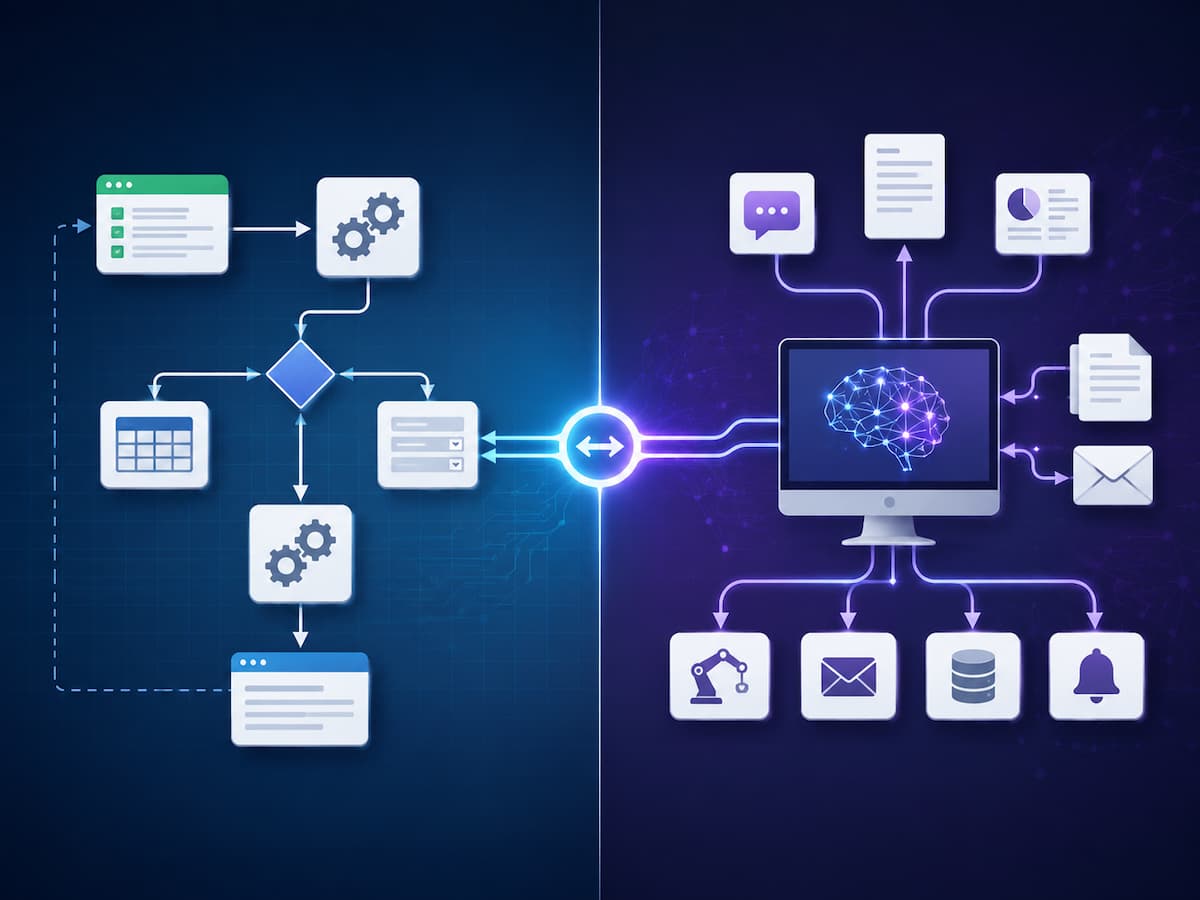
The difference between AI automation and traditional automation is therefore not simply a matter of old technology versus new technology. The two approaches solve different types of problems. Understanding that distinction can help you choose the right technology for a particular task instead of assuming that adding AI will automatically improve a workflow. This guide explains the key definitions, differences, strengths, limitations, costs, risks, and practical use cases of both approaches in clear terms.
What Is Automation?
Automation means using technology to perform a task with less direct human involvement. The task may be completely automatic, or it may involve a person at certain stages. The basic goal is to make a repeatable process faster, more consistent, or easier to manage. Consider an online shop that sends a confirmation email whenever a customer places an order. The system does not need a member of staff to manually send every message. A predefined event, the completed order, triggers a predefined action, sending the email. This is a straightforward form of automation.
Automation can be found in almost every area of technology. Websites use automated backups. Banks process recurring transactions. Businesses generate scheduled reports. Smartphones synchronise data across applications. Manufacturing systems control machinery. Email platforms filter incoming messages. The important point is that automation is a broad concept. Traditional automation and AI automation are both forms of automation, but they approach problems differently. Traditional systems generally follow instructions that humans have explicitly defined. AI-based systems may be able to interpret less structured information and produce an output based on patterns learned from data or instructions.
What Is Traditional Automation?
Traditional automation, sometimes called rule-based or deterministic automation, uses predefined instructions to complete a task. The system is given conditions, rules, workflows, or scripts that determine what should happen when specific events occur. A simple example is a customer support system that automatically sends a message when someone submits a form. The logic might be straightforward: if a form is submitted, create a support ticket and send a confirmation email.
Traditional automation is particularly effective when the process is predictable and the rules are clear. If the same input consistently produces the same result, a rule-based system is often an excellent choice. These systems do not necessarily need artificial intelligence. They can be built using software rules, scripts, application programming interfaces, databases, workflow platforms, scheduled tasks, or business process automation software. Traditional automation generally works best when you can clearly describe the process as a series of rules and conditions.
What Is AI Automation?
AI automation combines automated workflows with artificial intelligence capabilities. Depending on the system, the AI component may classify information, understand natural language, extract details from documents, identify patterns, generate text, analyse images, or make predictions. Imagine a company receiving hundreds of customer emails. A traditional system might route messages based on predefined keywords. An AI-powered system could analyse the meaning of each message and classify it as a billing question, technical issue, cancellation request, or general enquiry.
The AI does not necessarily replace the entire workflow. Instead, it handles the part of the process that is difficult to describe using simple rules. Once the AI has classified the message, traditional automation might take over and send it to the appropriate department. This is an important distinction. AI automation is often most useful when it is added to a workflow to handle unstructured or variable information rather than being used simply because AI is available.
The Key Difference Between the Two
The central difference is how the system handles inputs and decisions. Traditional automation typically relies on explicit rules. If condition A occurs, perform action B. If condition C occurs, perform action D. AI automation can handle situations where the input is more difficult to define in advance. Instead of requiring every possible phrase or variation to be manually programmed, an AI system may interpret the input and determine the most appropriate category or response.
For example, suppose a traditional workflow needs to identify urgent customer messages. A rule-based system might look for words such as “urgent”, “emergency”, or “immediately”. This can work, but customers may express urgency in many different ways. An AI system may be able to analyse the broader meaning of a message. However, that flexibility comes with a trade-off: the result may not always be predictable or correct. In simple terms, traditional automation usually follows explicit instructions, while AI automation can add interpretation and pattern recognition to an automated process.
AI Automation vs Traditional Automation: Comparison
| Factor | Traditional Automation | AI Automation |
|---|---|---|
| Basic approach | Follows predefined rules | Uses AI capabilities within an automated workflow |
| Best for | Predictable, repetitive tasks | Variable or unstructured tasks |
| Decision process | Explicit conditions and logic | May interpret patterns or content |
| Predictability | Usually highly predictable | Can be less predictable |
| Data types | Often structured data | Can work with structured and unstructured data |
| Human review | Often limited for routine tasks | May be needed for uncertain or high-risk outputs |
| Maintenance | Rules may need updating when processes change | Prompts, models, integrations, and workflows may need review |
| Typical strength | Consistency and control | Flexibility and interpretation |
Neither approach is automatically better. The right choice depends on the problem. If you need to move an invoice from one system to another every time you record a payment, traditional automation may be sufficient. When invoices arrive in different layouts and you need to extract information from them, an AI component may be useful.
How Traditional Automation Works
A traditional automated workflow usually begins with a trigger. The trigger might be a scheduled time, a new record in a database, a completed transaction, or an action taken by a user. The system then applies predefined logic. It may check conditions, transform information, update records, or communicate with another application. Because the rules are explicitly defined, developers and administrators can often predict what will happen before the workflow runs.
For example, an employee submits a holiday request through an internal system. The automation checks whether the request has been approved. If it has, the system updates the employee’s calendar and sends a notification to the relevant team. This type of automation is powerful because it is clear and repeatable. However, it can struggle when information does not fit the expected structure. A workflow designed for a standard digital form may not know what to do with a handwritten document, an unusual email, or a vague customer request.
How AI Automation Works
AI automation introduces an AI-powered step into the workflow. The AI may receive text, images, audio, documents, or other information and produce an interpretation or output that the rest of the workflow can use. For example, imagine an organisation that receives supplier invoices in different formats. Traditional automation may struggle because the invoice layouts are inconsistent. An AI-enabled system could help identify the supplier name, invoice number, date, and total amount even when these details appear in different locations.
The workflow could then pass the extracted information to a traditional system that validates the data and records the invoice. This combination illustrates how AI and traditional automation can complement each other. AI handles interpretation, while deterministic software handles actions that require consistent rules. AI automation does not mean that every part of a workflow needs to use AI. Often, AI is most valuable when used for one specific step that traditional automation cannot handle efficiently.
Predictability and Control
One of the most significant differences between traditional and AI automation is predictability. Traditional automation is usually easier to test because the same conditions generally produce the same result. If a rule states that orders over a certain amount require approval, the workflow can apply it consistently. AI systems can be more flexible, but their outputs may vary. A language model, for example, may interpret two similar requests differently. An image recognition system may occasionally misclassify something. A generative AI system may produce an answer that sounds reasonable but contains incorrect information.
This does not make AI automation unsuitable. It simply means that workflows should be designed with appropriate safeguards. A low-risk task might allow AI output to move forward automatically. A high-risk task may require a person to review the result first. The choice between flexibility and predictability should therefore be based on the consequences of mistakes. If an error could cause serious financial, legal, safety, or operational problems, stronger controls are usually appropriate.
The Role of Data
Traditional automation often works best with structured data. Structured information fits predictable fields such as names, dates, order numbers, and prices. The system knows where to find each value and what to do with it. AI automation can be useful when information is less structured. Emails, documents, photographs, recordings, and natural-language messages are examples of data that may not follow a fixed format.
However, AI does not eliminate the importance of data quality. Poor-quality information can still produce poor results. An AI system may misunderstand incomplete documents, ambiguous language, or low-quality images. Organisations should therefore consider how information is collected, stored, protected, and reviewed. Data privacy is another major consideration. When AI systems process personal or confidential information, users should understand how the data is handled. The appropriate safeguards depend on the technology, the organisation, the type of data, and applicable legal requirements.
Real-World Examples
Consider email management. A traditional automation system can move messages from a known sender into a particular folder. It can also trigger actions based on fixed rules. This works well when the conditions are clear. AI automation can add a layer of interpretation. It might analyse the meaning of incoming messages and classify them by topic. The traditional workflow can then route the messages based on the AI’s classification.
Document processing provides another example. Traditional automation is excellent at handling documents with consistent structures. AI can help when documents vary significantly in layout or wording. Customer service can also benefit from both approaches. Traditional automation can send order confirmations, update ticket statuses, and trigger notifications. AI can help summarise conversations, classify requests, and draft responses for human review. In each example, the important question is not whether AI is involved. The better question is which parts of the process need interpretation and which can be handled by straightforward rules.
Why Hybrid Automation Can Be the Best Option
Many effective modern workflows combine AI with traditional automation. This hybrid model uses each technology where it is strongest. Imagine a company receiving customer feedback. An AI system analyses each message and identifies its general topic and sentiment. A rule-based workflow then records the information in a database and alerts the appropriate team when it meets certain conditions.
The AI handles the difficult interpretation. The traditional automation handles the predictable actions. This approach can also reduce risk. Instead of allowing AI to make an unrestricted decision, the workflow can establish boundaries. For example, AI may recommend a category, but a predefined rule can determine what happens next. If confidence is low or the situation appears unusual, the workflow can send the case to a person. Hybrid automation is often a practical middle ground because it avoids forcing one technology to solve every part of the problem.
Advantages and Limitations
Traditional Automation: Strengths
- Highly predictable for clearly defined tasks.
- Usually easier to test and troubleshoot.
- Works well with structured data.
- Can provide strong control over business rules.
- Often suitable for repetitive processes that rarely change.
Traditional Automation: Limitations
- Can struggle with unstructured information.
- May require many rules to handle exceptions.
- Changes to the process can require workflow updates.
- Complex rule sets can become difficult to maintain.
AI Automation: Strengths
- Can work with natural language and other unstructured inputs.
- Can identify patterns that are difficult to define with simple rules.
- Can assist with classification, summarisation, and content generation.
- Can make some workflows more adaptable to variation.
AI Automation: Limitations
- Outputs may not always be predictable.
- AI-generated results can contain errors.
- Human review may be necessary for important decisions.
- Privacy and data governance require careful attention.
- Implementation can be more complex than a simple rule-based workflow.
The key lesson is that every advantage comes with a corresponding responsibility. AI provides flexibility, but flexibility requires stronger oversight. Traditional automation provides control, but this control may require more explicit rules.
How to Choose the Right Approach
Start by describing the task without mentioning technology. Ask what needs to happen, what information enters the process, and what result should come out. If you can express the process clearly as a set of rules, traditional automation may be the simplest option. For example, “When a new order is paid, update the record and send a confirmation email” is a highly predictable workflow.
If the process requires interpretation, AI may be worth considering. For example, “Read this customer message and determine what problem the person is describing” involves language understanding that may be difficult to capture with simple rules. Next, consider the cost of mistakes. If an incorrect result is harmless and easy to correct, AI may be appropriate. If an incorrect decision could cause serious consequences, consider adding human review or using deterministic rules for the final action. Finally, ask whether AI provides enough additional value to justify its complexity. If traditional automation already solves the problem effectively, adding AI may make the workflow harder to manage without delivering a meaningful improvement.
Practical rule: Use traditional automation when the rules are clear. Consider AI when interpretation is the difficult part. Use a hybrid approach when you need both flexibility and control.
Common Mistakes to Avoid
One common mistake is assuming that AI is always more advanced and therefore always better. Technology should be selected according to the problem, not according to how modern it sounds. Another mistake is using AI where a simple rule would be more reliable. If a system only needs to verify whether a payment has been received, there may be no reason to ask an AI model to make that determination.
It is also a mistake to automate a broken process. Automation can make a poor process faster without improving it. Before automating anything, understand the existing workflow and remove unnecessary steps where possible. Finally, organisations should avoid creating AI workflows that lack clear monitoring. A system that works well during testing may behave differently when it encounters new types of information. Regular review helps identify errors and unexpected behaviour before they become bigger problems.
Conclusion
AI automation and traditional automation are not competing technologies in every situation. They are different approaches to automating work, and each has a place in modern technology. Traditional automation is strongest when processes are predictable and rules can be clearly defined. It offers consistency, control, and reliable execution. AI automation adds capabilities that can help systems work with language, images, documents, patterns, and other forms of information that are difficult to manage through fixed rules alone.
The most important decision is therefore not whether AI is newer or more impressive. It is whether AI actually solves a problem that traditional automation cannot handle efficiently. If a simple rule works, use it. If interpretation is the difficult part, AI may add value. If you need both flexibility and dependable execution, combining AI with traditional automation may be the most practical approach.
Understanding this distinction helps individuals and organisations make better technology decisions. Instead of automating for the sake of automation, focus on the process, the data, the risks, and the result you need. That is the foundation for building automation systems that are useful, reliable, and easier to manage over time.
References
The following organisations provide reliable information and guidance on artificial intelligence, automation, risk management, and responsible technology use:
- National Institute of Standards and Technology (NIST) — Artificial Intelligence Risk Management Framework and related AI resources.
- Organisation for Economic Co-operation and Development (OECD) — Artificial Intelligence Principles and AI policy resources.
- UNESCO — Recommendation on the Ethics of Artificial Intelligence.
- European Commission — Artificial Intelligence Act and European Union AI policy information.
- UK Information Commissioner’s Office (ICO) — Guidance on artificial intelligence, data protection, and privacy.
- International Organization for Standardization (ISO) — Standards and guidance relating to artificial intelligence and automation.

Samira Patel is a tech writer who believes the best tools are the ones you actually use. She tests every app, shortcut, and workflow on her own laptop before sharing it—no recommendations she hasn’t lived with herself. When she’s not figuring out why a computer is running slow, she’s probably reorganizing her cloud storage (again). She writes to help busy people find simpler, smarter ways to work. No hype, just what works.